
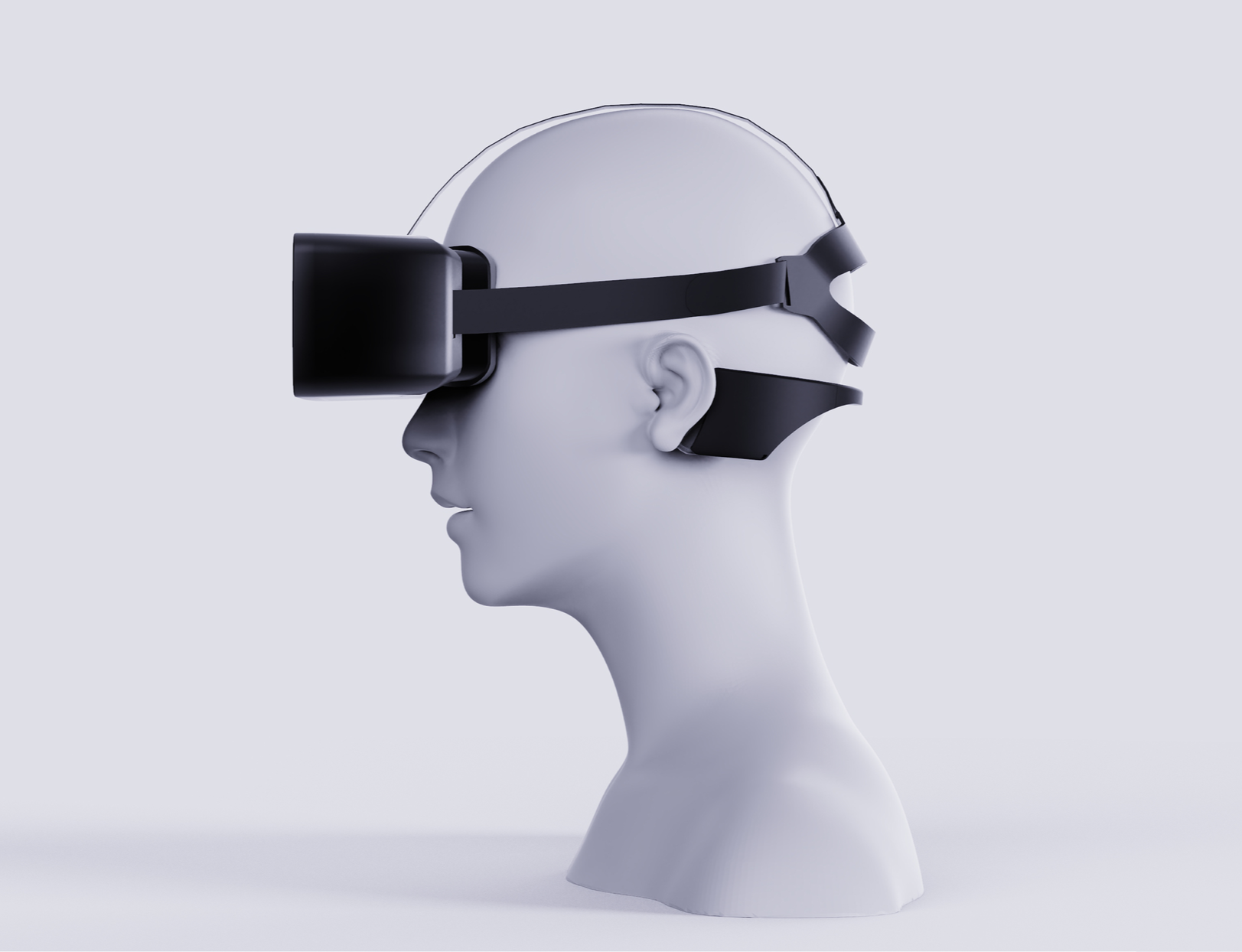

Anti motion sickness immersive experience device
AMS+ A wearable concept exploring vestibular support for more comfortable VR
AMS+ translates an emerging vestibular-stimulation hypothesis into a wearable product platform—combining industrial design, fit-and-form prototyping, and a proposed cross-device interaction system for more comfortable immersive experiences. This is an industry-academia collaboration project with WiseChip Semiconductor Inc. and TSGS. This conceptual design won the Young Pin Design Award Silver in 2022.

x

x

AMS+ Anti motion sickness immersive experience device
PROJECT
2021-2022
YEAR
Industrial Design Lead; research synthesis, form development, prototyping, CMF and product UX (End-to-End Solo Project)
ROLE
Functional fit-and-form prototype; efficacy and closed-loop control remain proposed
STATUS
WiseChip Semiconductor Inc. and TSGS
CLIENT
YODEX Young Designers’ Exhibition ‘22, Taiwan
EXHIBITION
*Industry-Academia Collaboration & Competition, Silver
AWARDS
PRESS / MEDIA / TALK
Overview
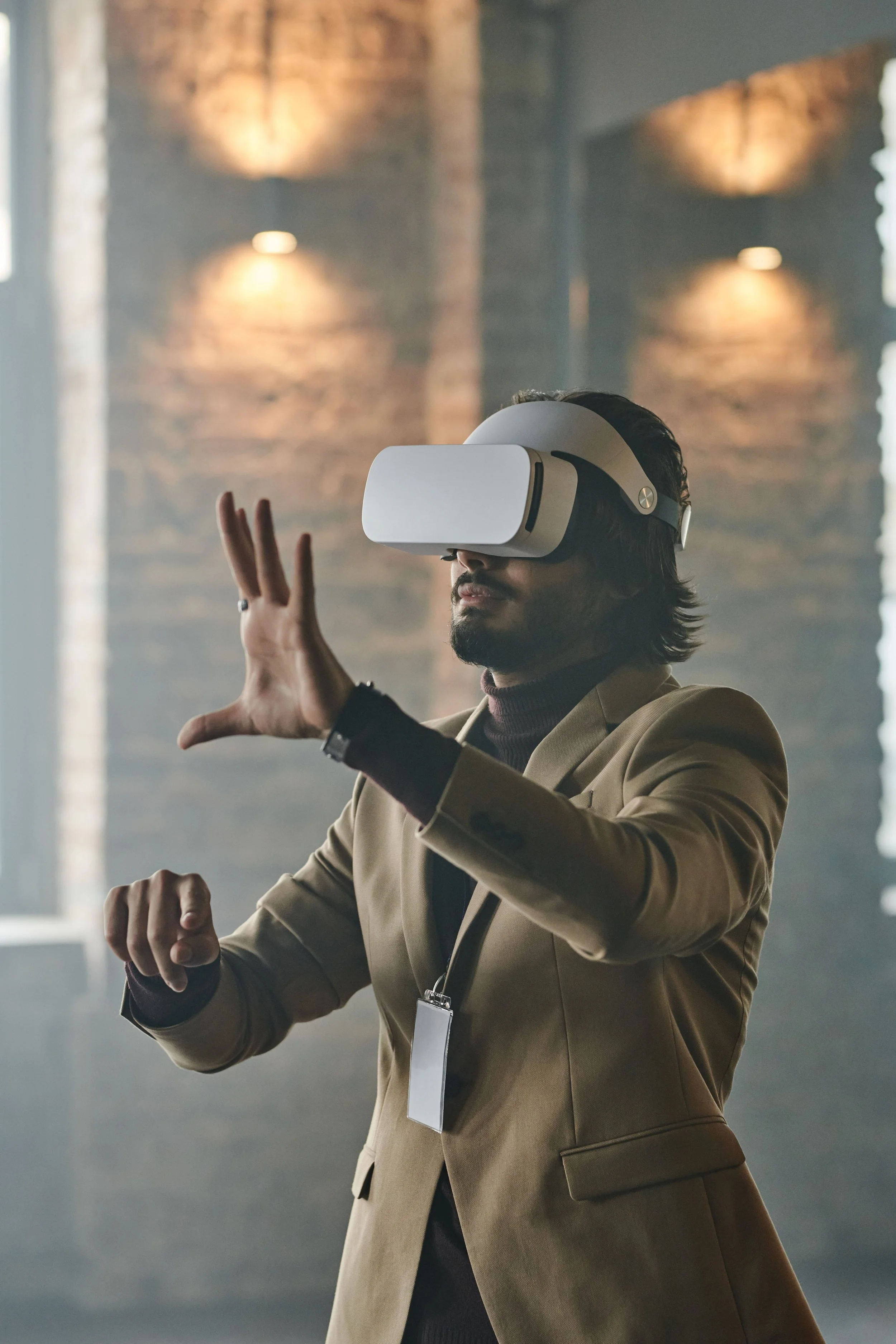
AMS+ is a wearable concept exploring a more comfortable VR experience. Starting with the mismatch between what users see and what their vestibular system senses, it investigates whether low-intensity stimulation behind the ears could offer another approach to immersive comfort.
AMS+ is a technology-led product concept that applies non-invasive galvanic vestibular stimulation (GVS) to enhance immersion. Inspired by traditional Chinese medicine acupoint theory and grounded in contemporary neurophysiology, the system delivers a precisely controlled, low-amplitude current via electrodes positioned over the mastoid processes behind the ears to gently modulate vestibular input. By reducing visual-vestibular mismatch, AMS+ increases users’ sense of presence and enables a richer, more stable immersive experience.
Status: Proof-of-Concept / Wearable functional prototype、proposed closed-loop system · Fit-and-form feasibility explored through functional prototyping
Keyword: VR Comfort Exploration · Wearable Interaction Design · Vestibular Stimulation Concept
Immersion, without the discomfort
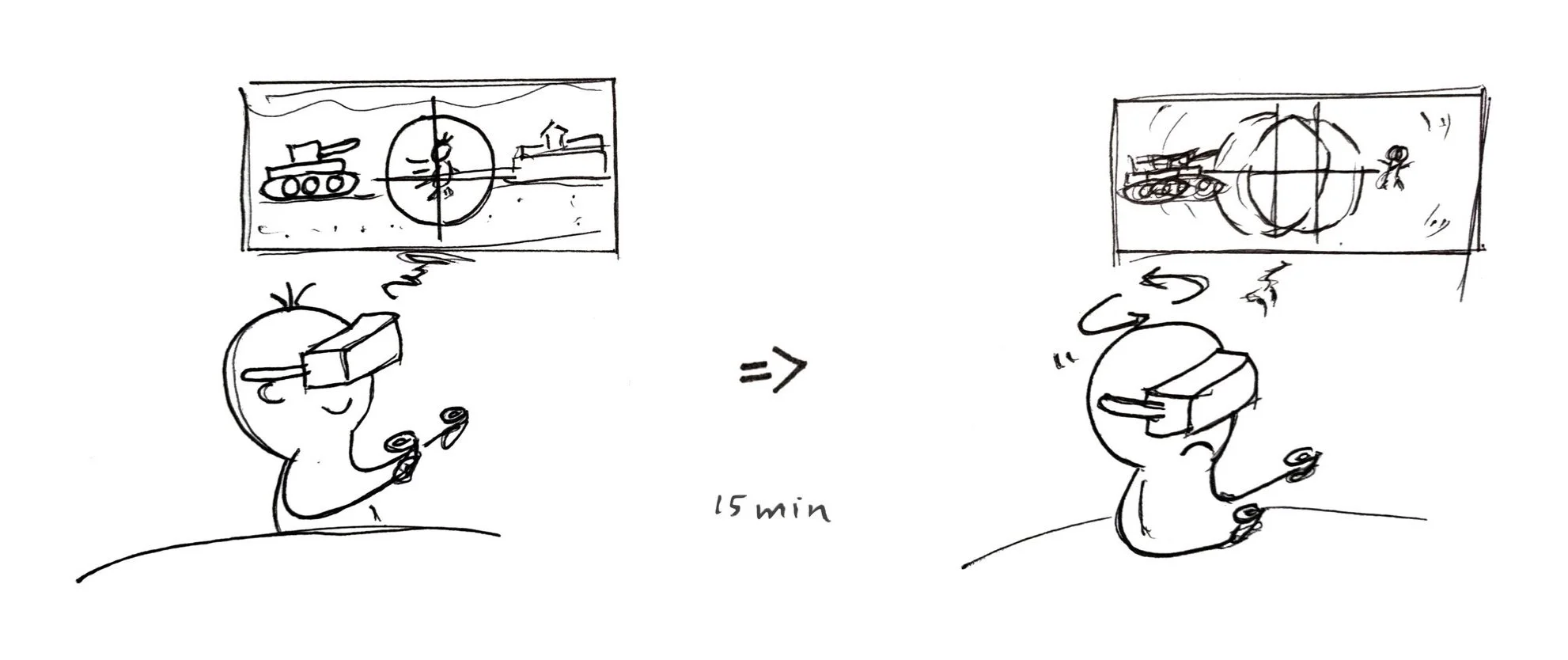
In some VR/AR experiences, the visuals suggest that a person is moving, turning, or accelerating while their body remains still. This sensory mismatch is one important explanation for cybersickness. Nausea, dizziness, disorientation, and eye discomfort can shorten a session or bring it to an early stop. AMS+ asks a different design question: how might more people stay comfortably engaged in immersive experiences?
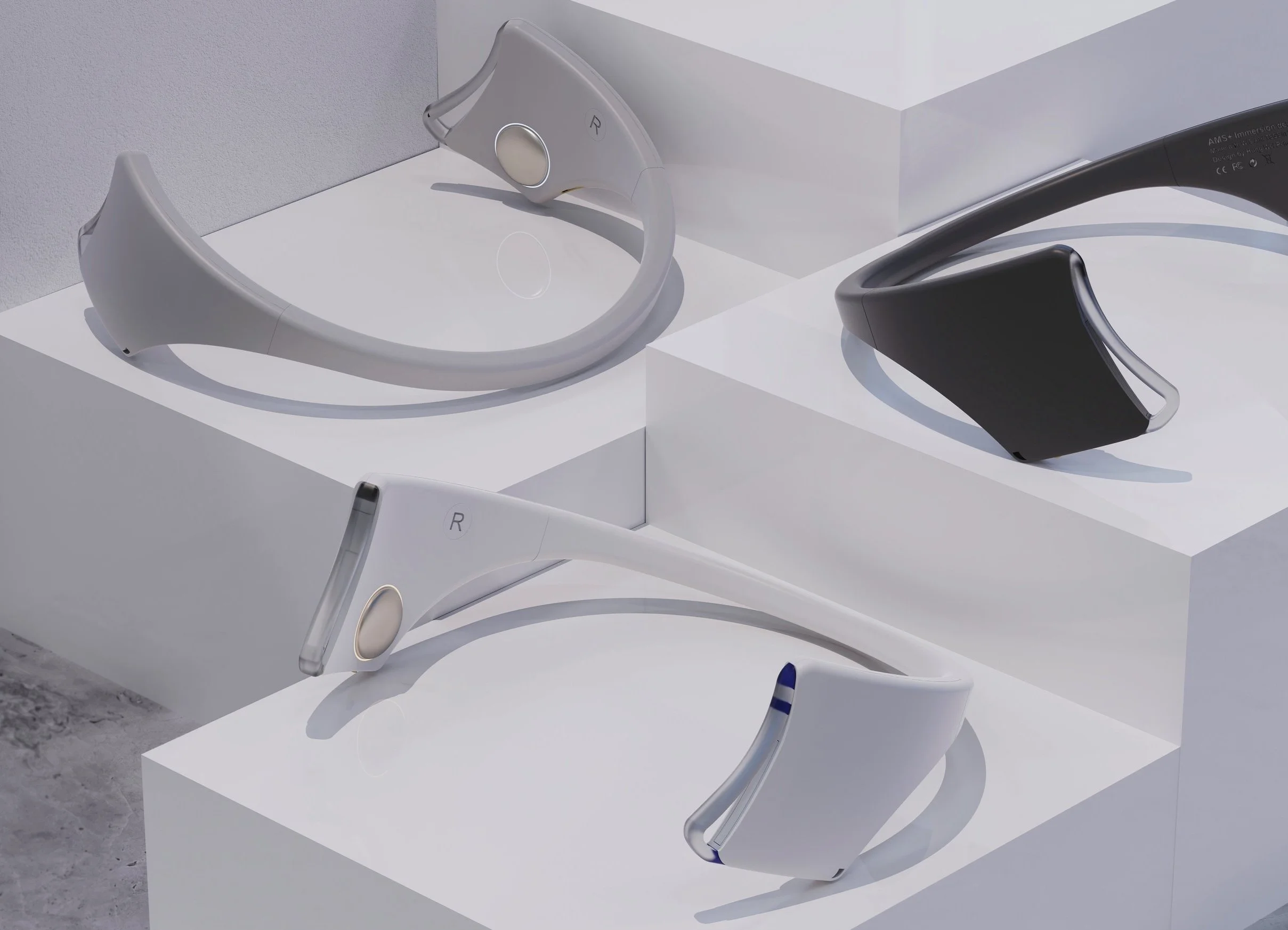
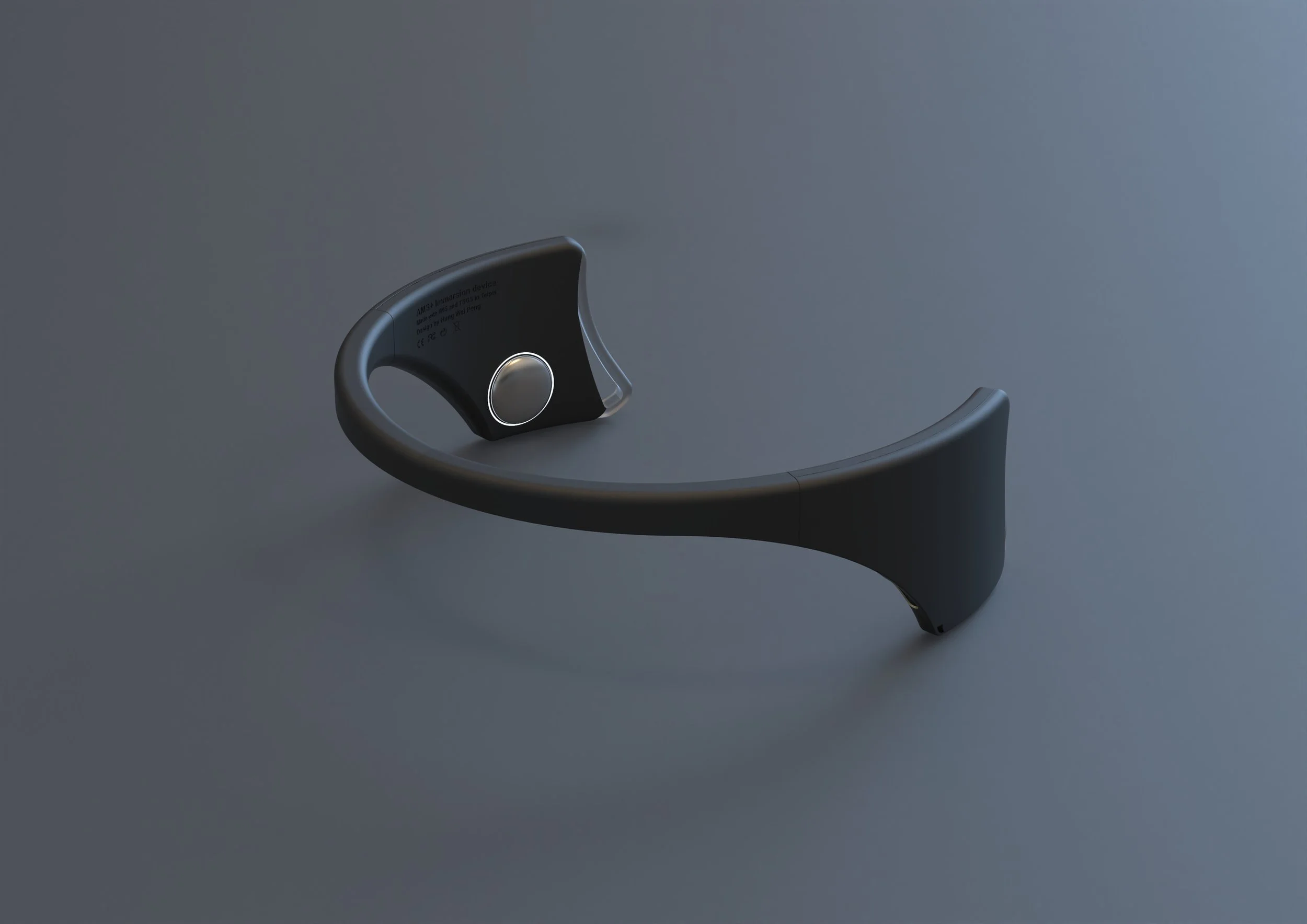
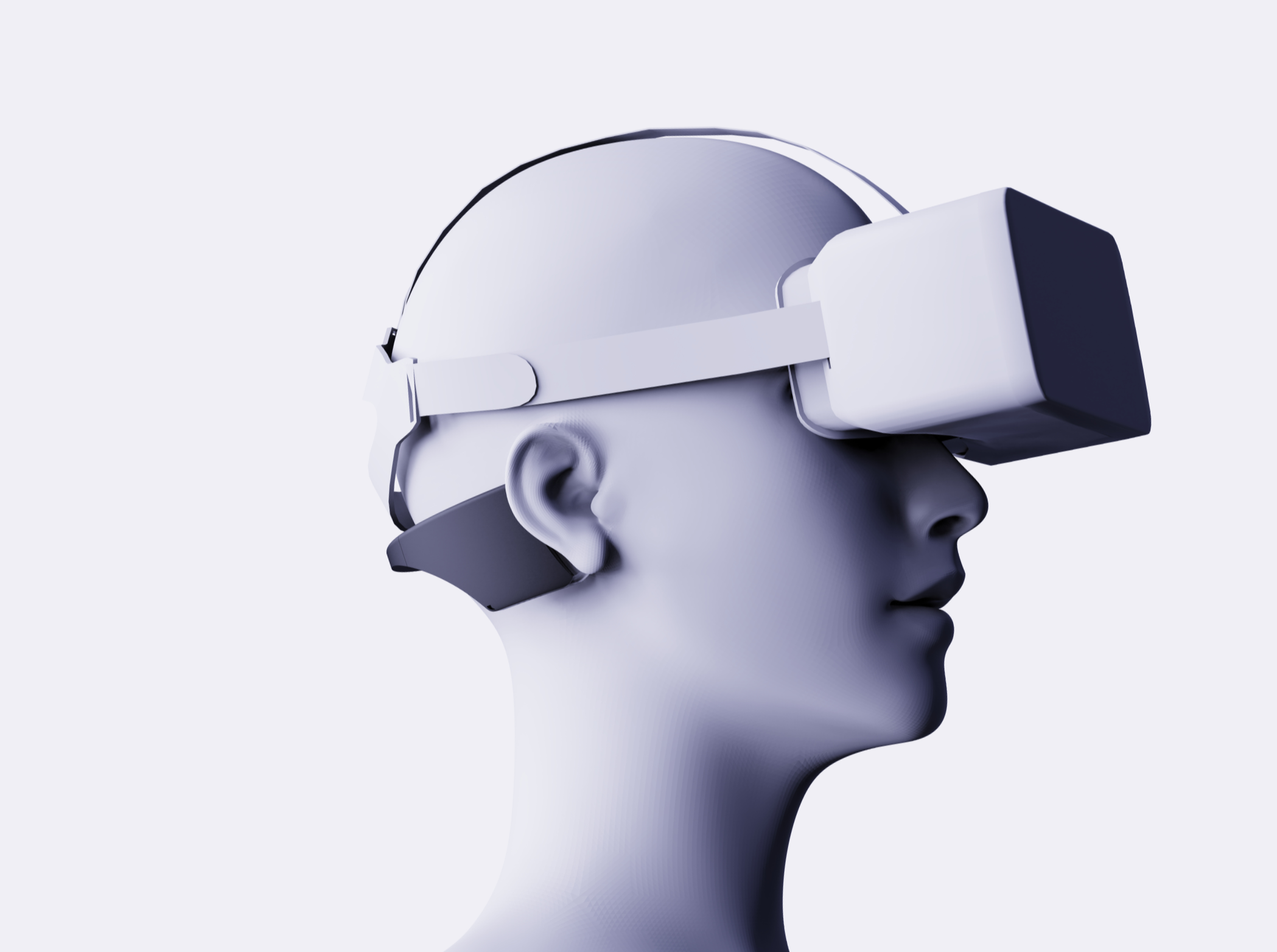
Core FeatureThe AMS+ concept places electrical-stimulation contact points near the mastoid region behind the ears in a lightweight, portable form designed to be worn alongside a VR headset. The portfolio shows an occipital clip, transparent silicone retaining straps, a titanium-alloy frame, enclosure exploration, and successive physical models.
Reducing visuals to rethinking sensory dialogue
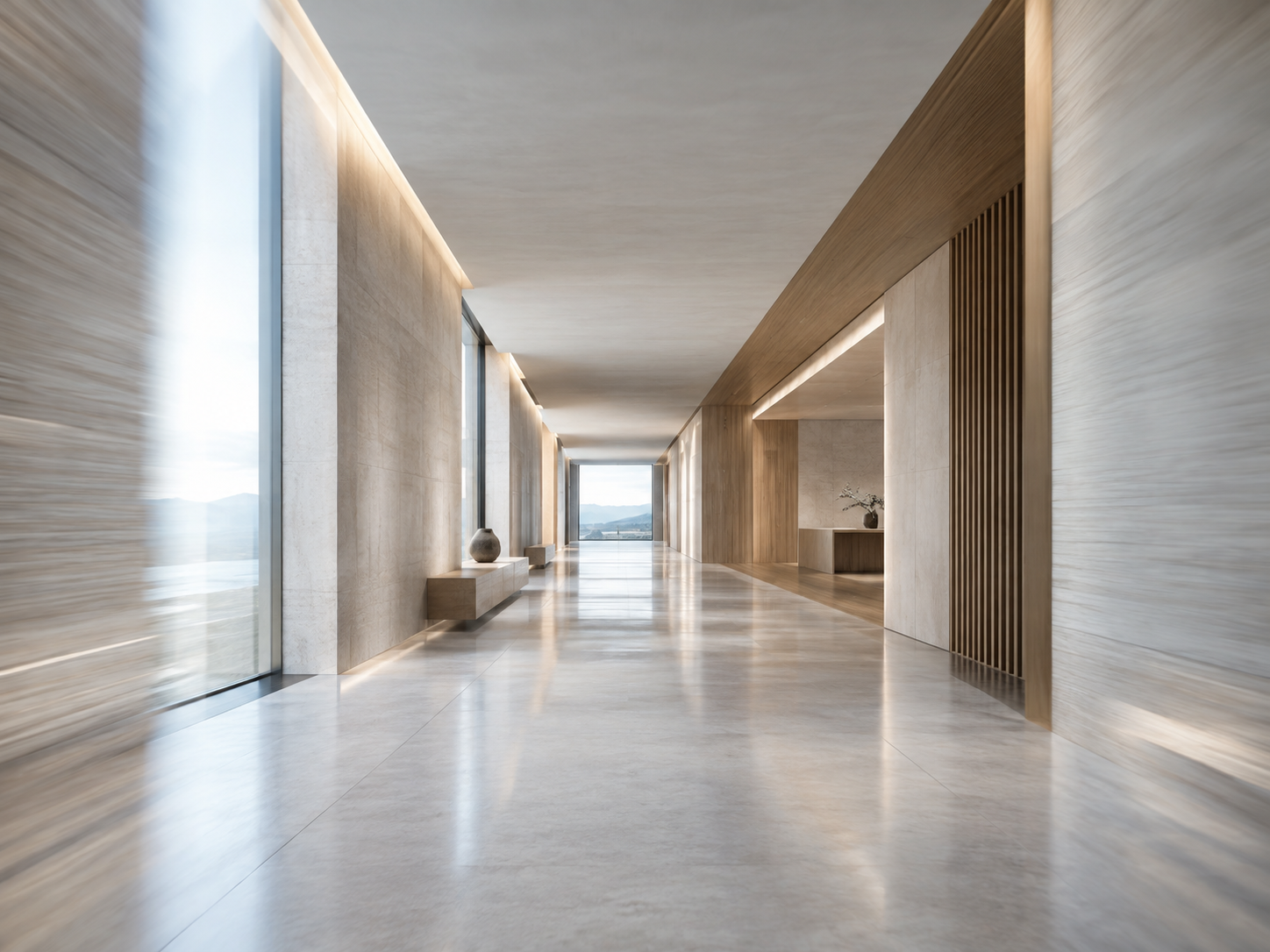
Most approaches to reducing VR discomfort begin with the image itself: slowing down movement, narrowing the field of view, reducing camera motion, or limiting session duration. While these methods may reduce discomfort for some users, they can also compromise immersion, spatial presence, and creative freedom.
AMS+ begins with a different question:
Instead of only changing what users see, what if we reconsider the relationship between visual input, bodily sensation, and the vestibular system?
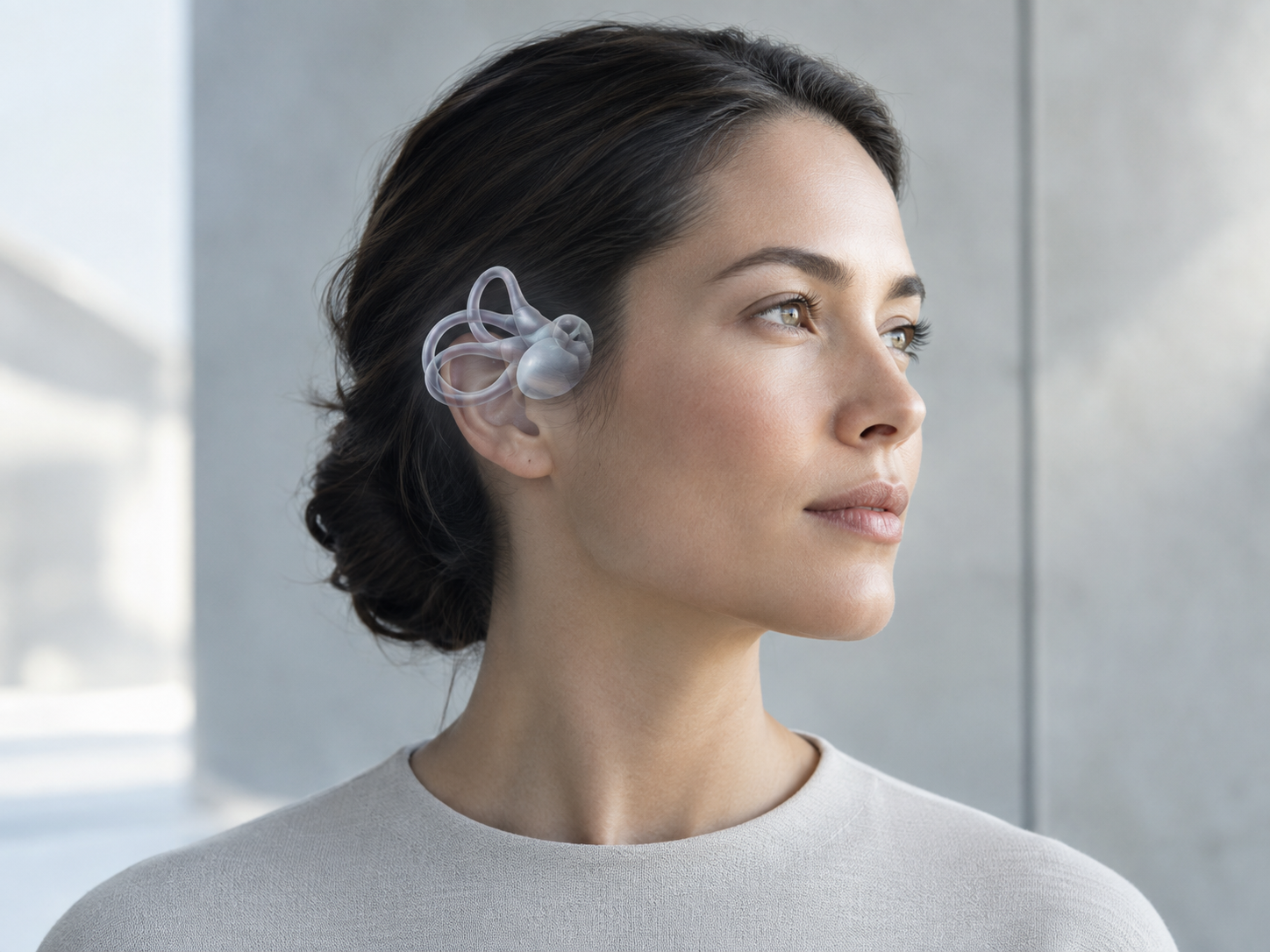
The concept therefore focuses on the mastoid area behind the ears. This location sits near the vestibular system, which contributes to balance and spatial orientation, and is commonly used as an electrode placement area in vestibular-stimulation research. AMS+ explores low-intensity electrical stimulation as a sensory intervention—adding another designable bodily signal to visually led immersive experiences.

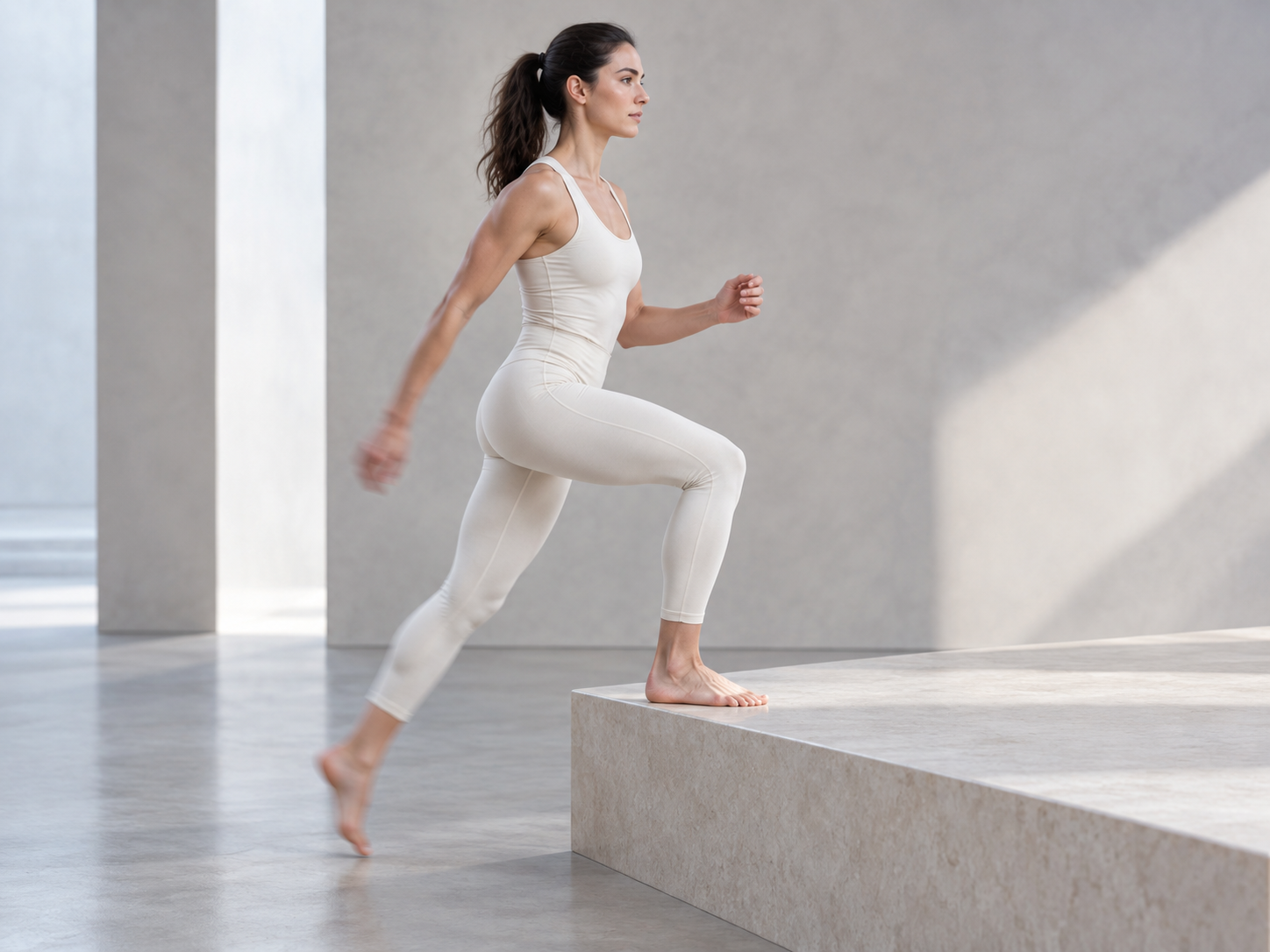
Three Sensory Layers
Vision: Perceiving motion, speed, depth, and space.
Somatosensory & Proprioceptive System: Sensing posture, muscle activity, gravity, and physical movement.
Vestibular System: Supporting balance, orientation, and the perception of head movement.
If the gap between sensory signals can be addressed more thoughtfully, VR may shift from an experience users endure to one they can explore for longer and with greater focus.
Design Imagery

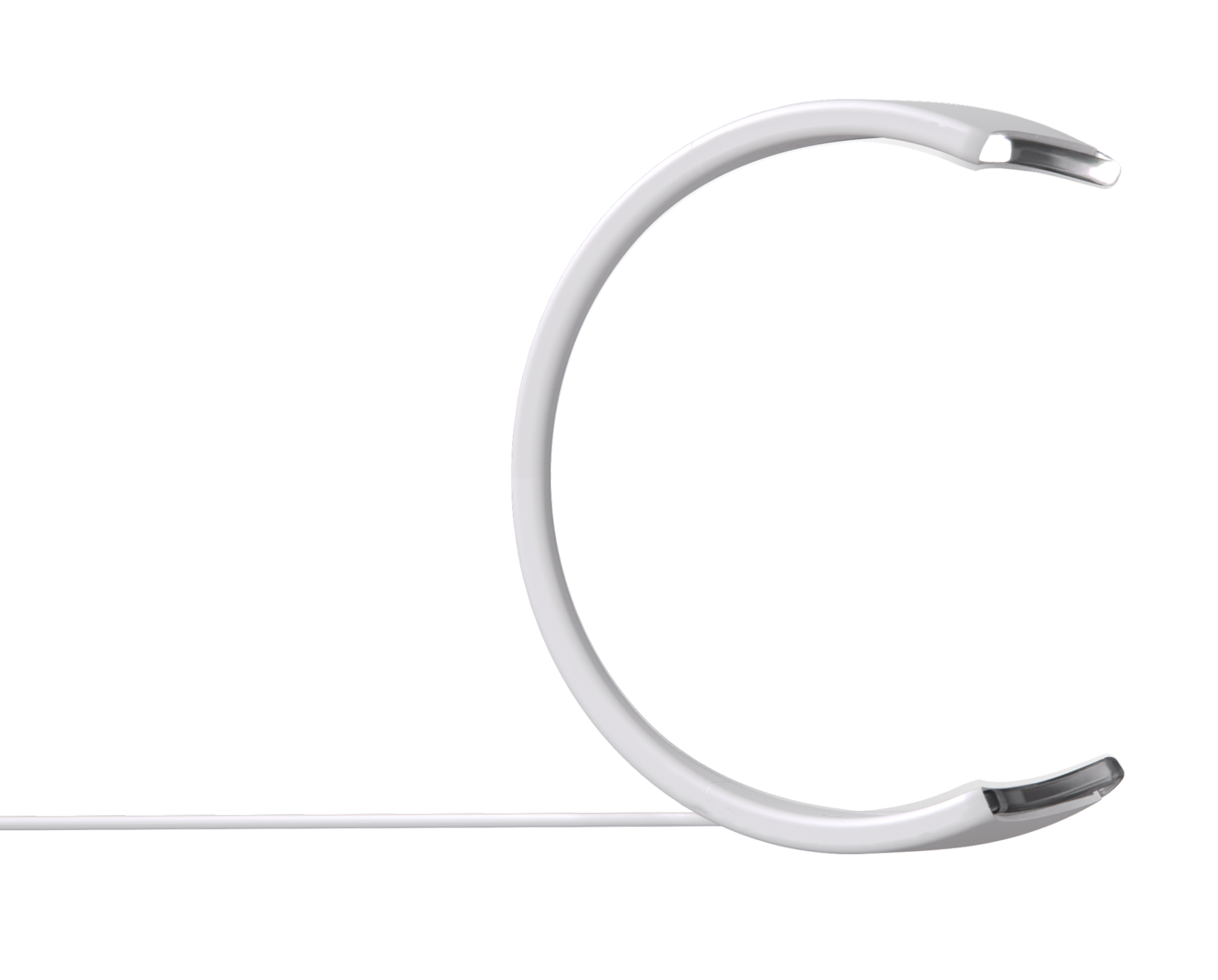
Engineered to help alleviate dizziness, the product adopts a streamlined silhouette with gentle, inviting lines—minimal without feeling clinical. A rounded anode electrode and a transparent silicone band present crisp, clean tones, culminating in a visual presence that is quiet, modern, and elegantly understated.
IDEA Sketch
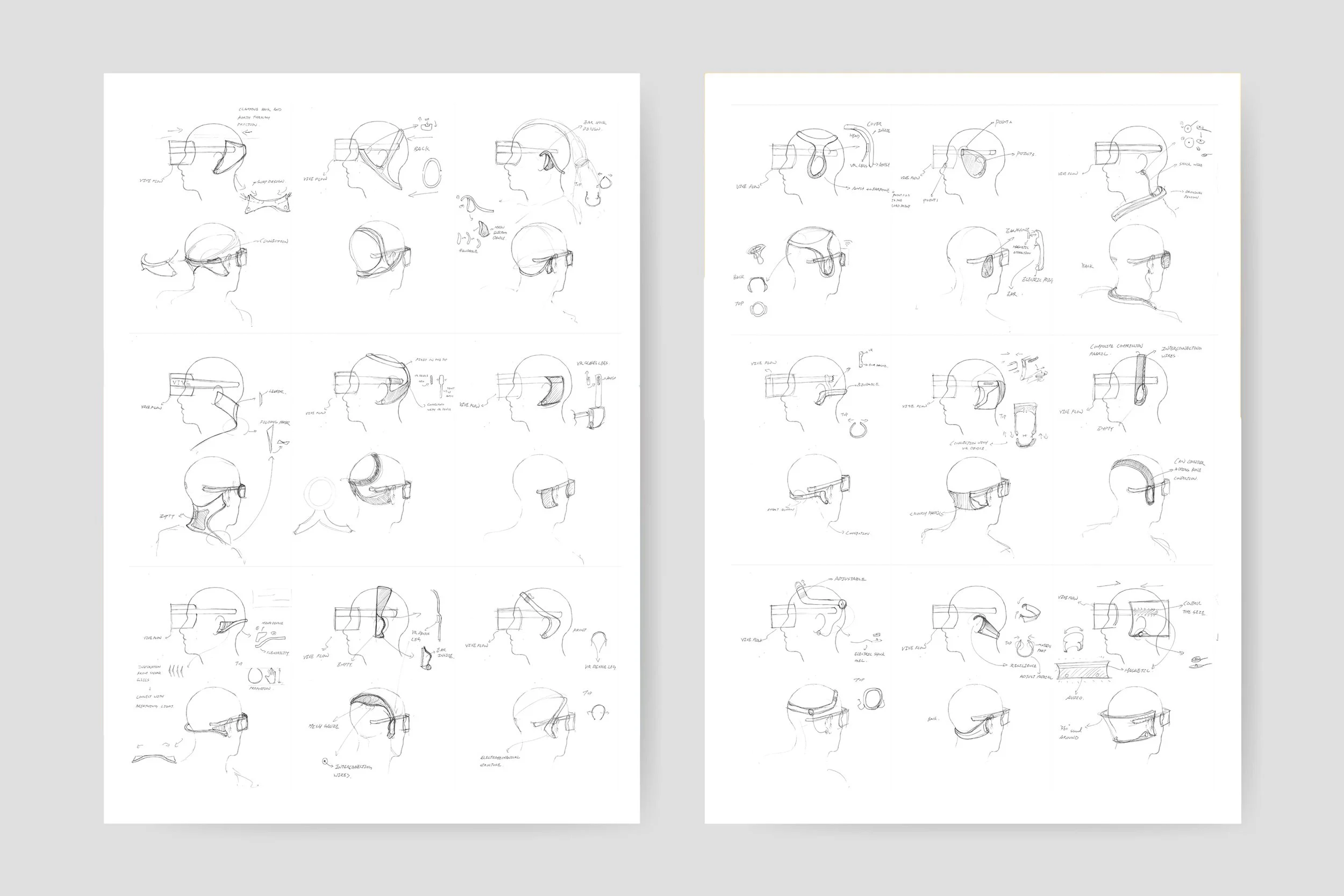
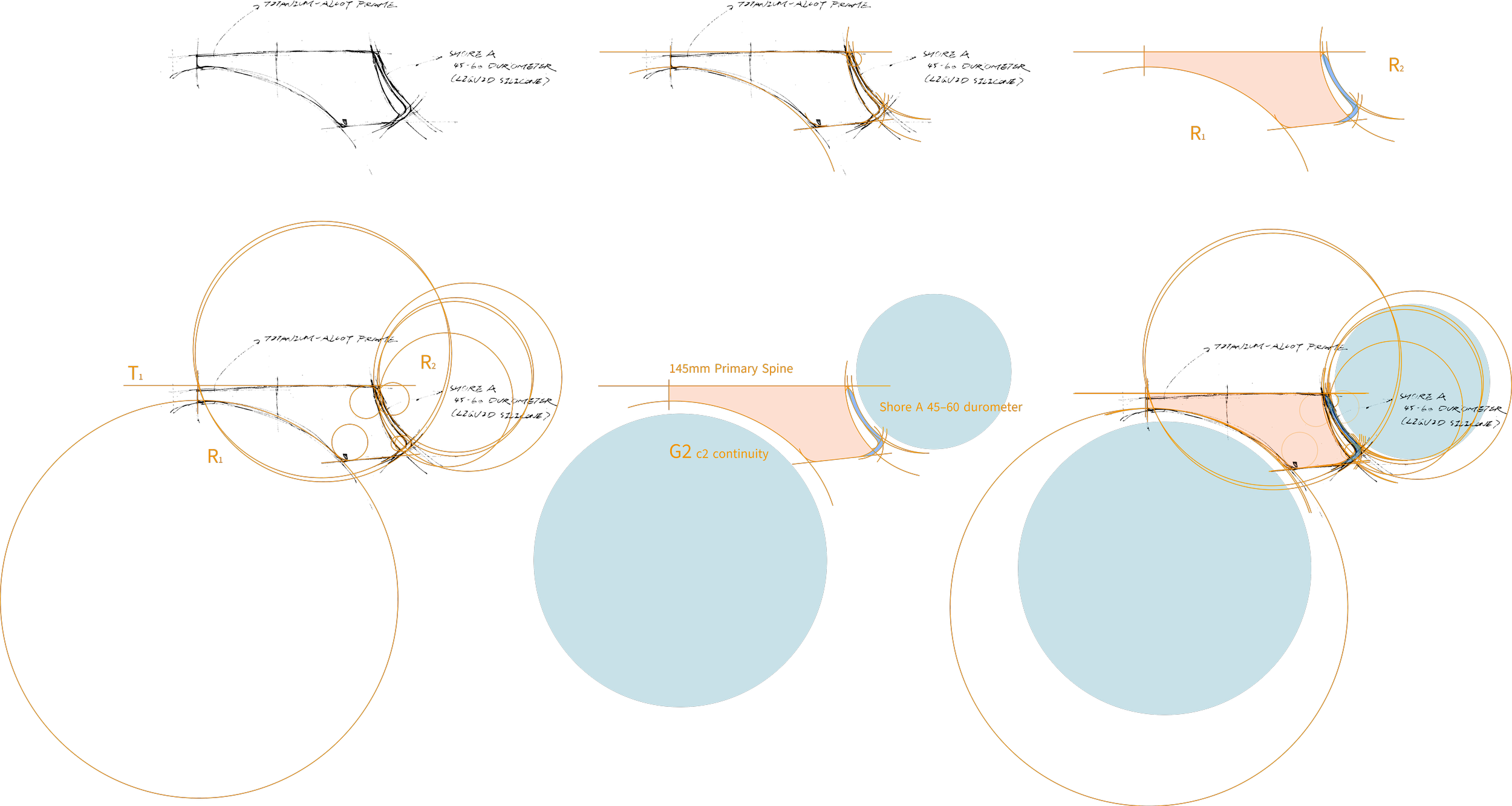
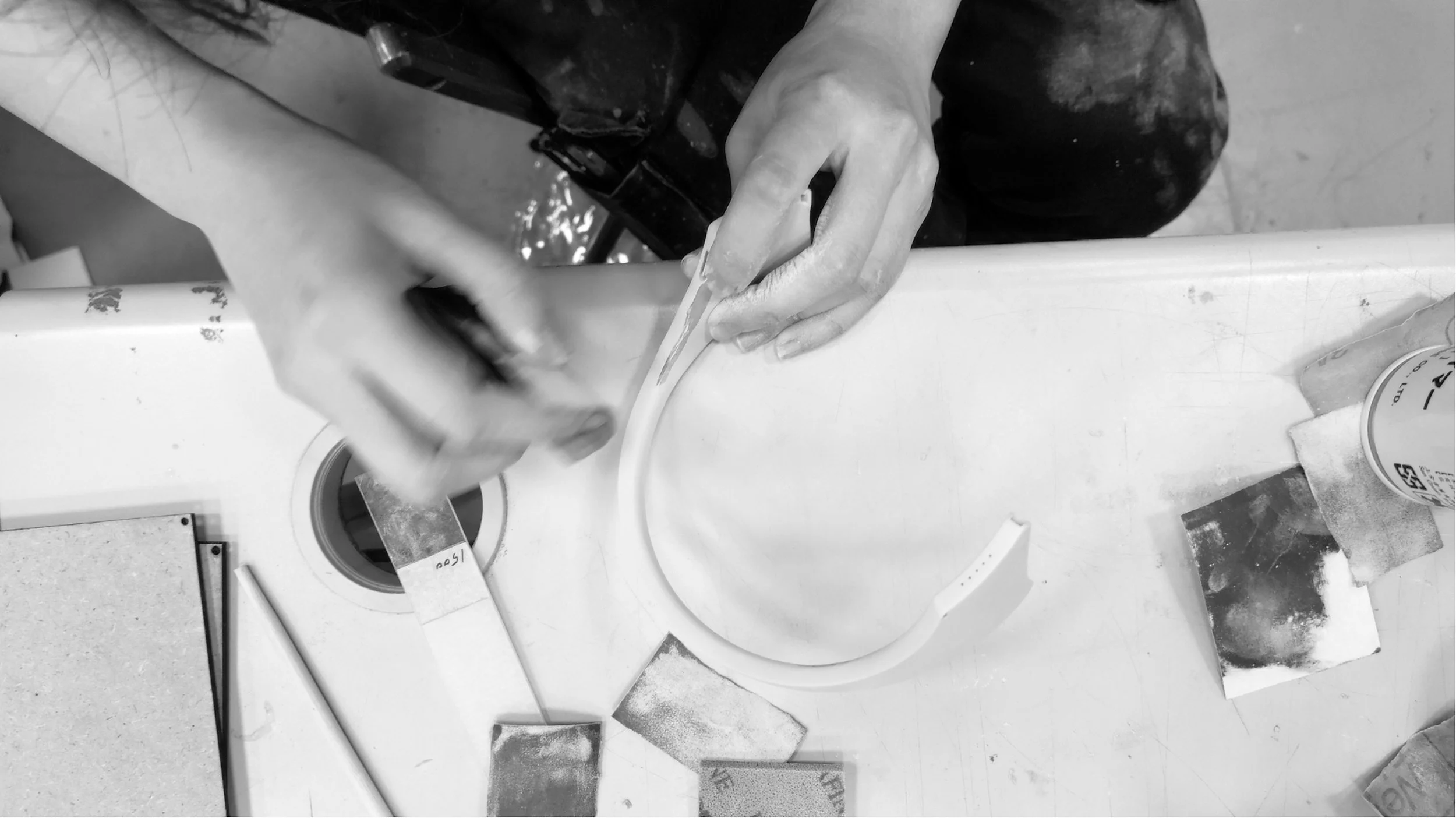
Early sketches explored a range of wearable forms, including concepts integrated directly into a VR headset. Through discussions with industry partners and successive prototypes, the design evolved into a standalone rear-head clip—an approach that balances manufacturability, simplicity, and compatibility with different VR setups. Sculpted ends sit behind the ears, with transparent silicone contact edges designed to support a secure, comfortable fit.
THE PRODUCT
Designed for immersion.
Shaped for comfort.
Designed for immersion. Shaped for comfort
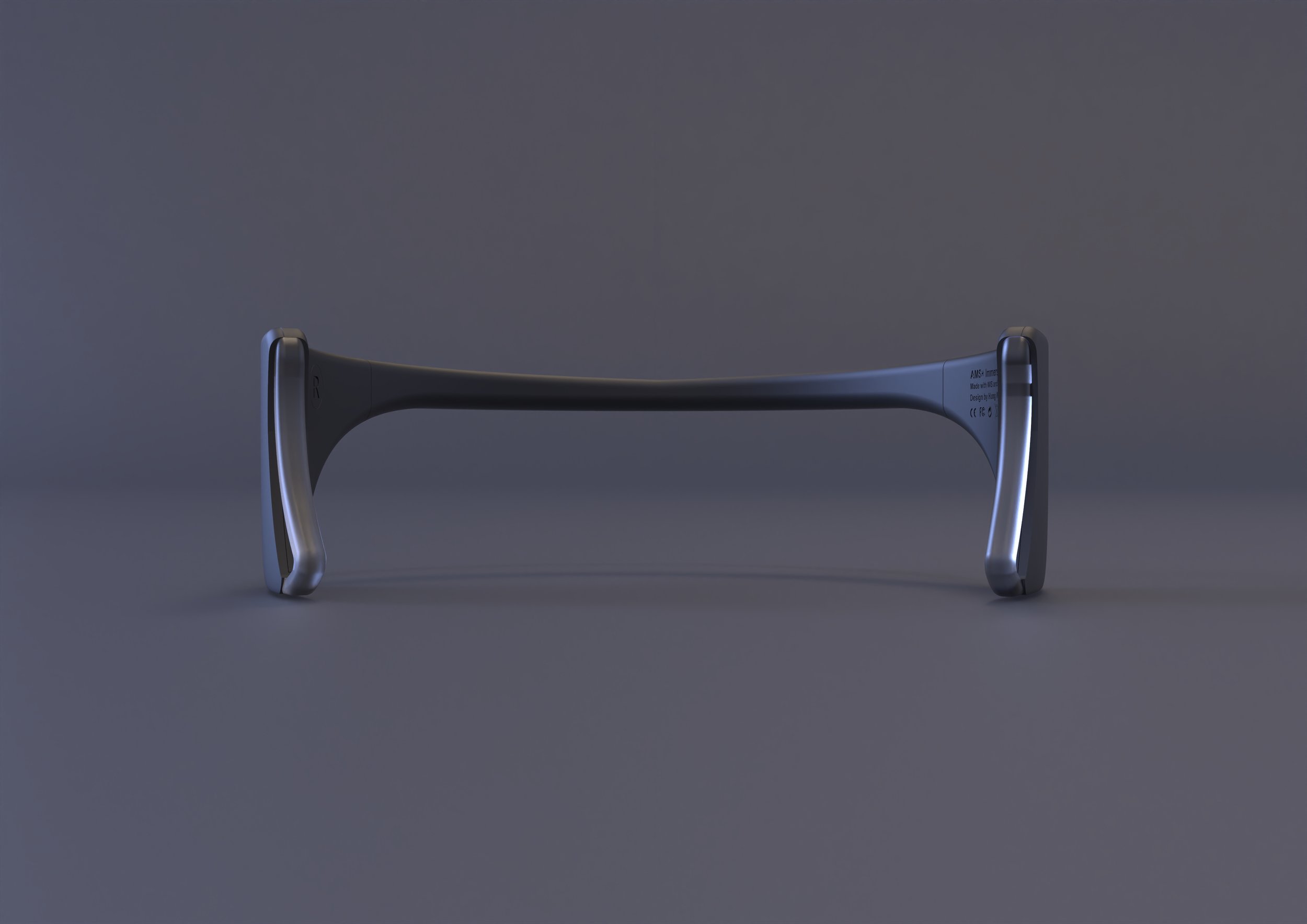
AMS+ is a lightweight wearable concept that rests behind the head and explores gentle electrical stimulation near the ears. Its sculpted form pairs a titanium-alloy frame with transparent silicone contact edges—designed to sit alongside a VR headset, not replace it.
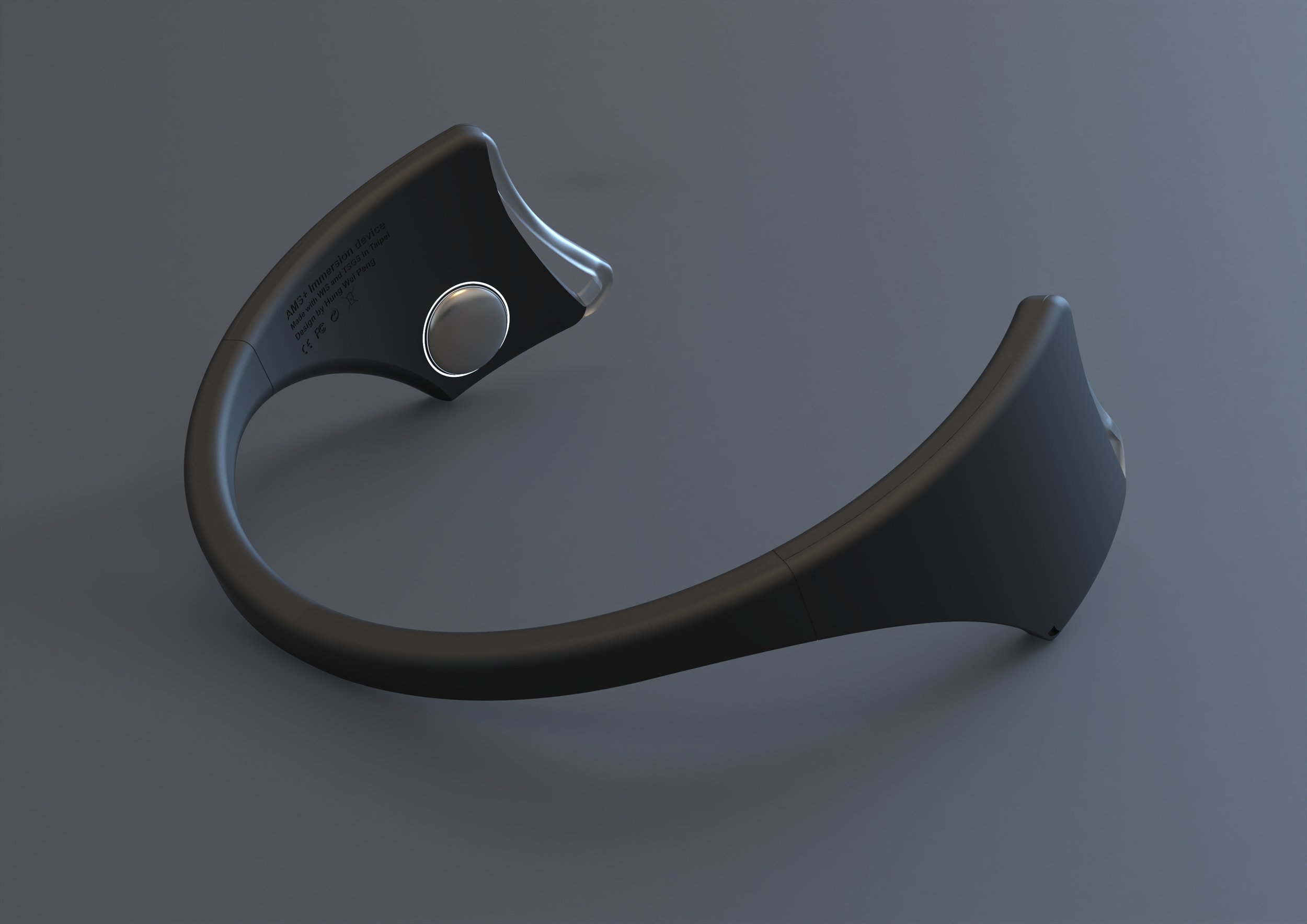
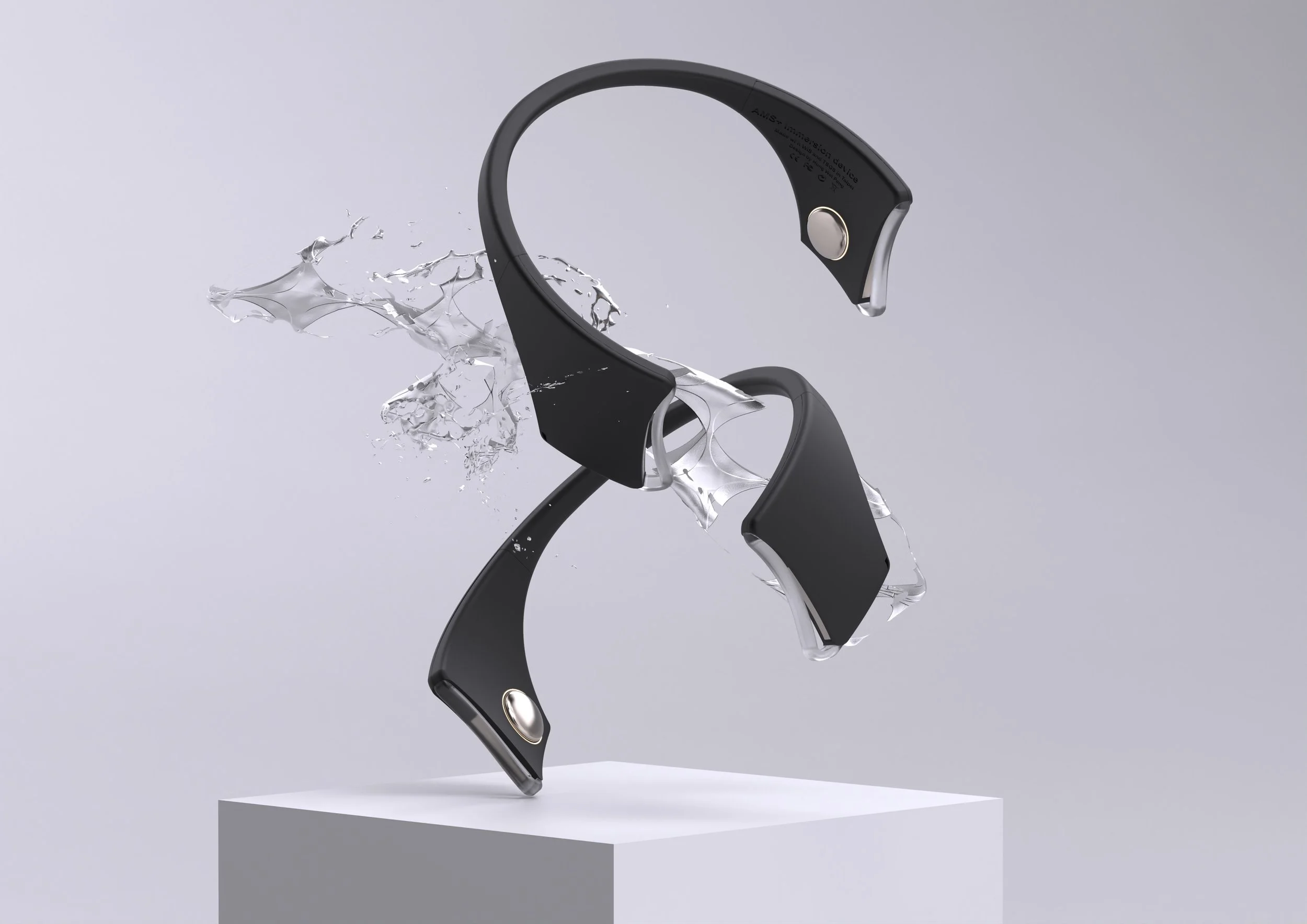
Prototype/ Functional type
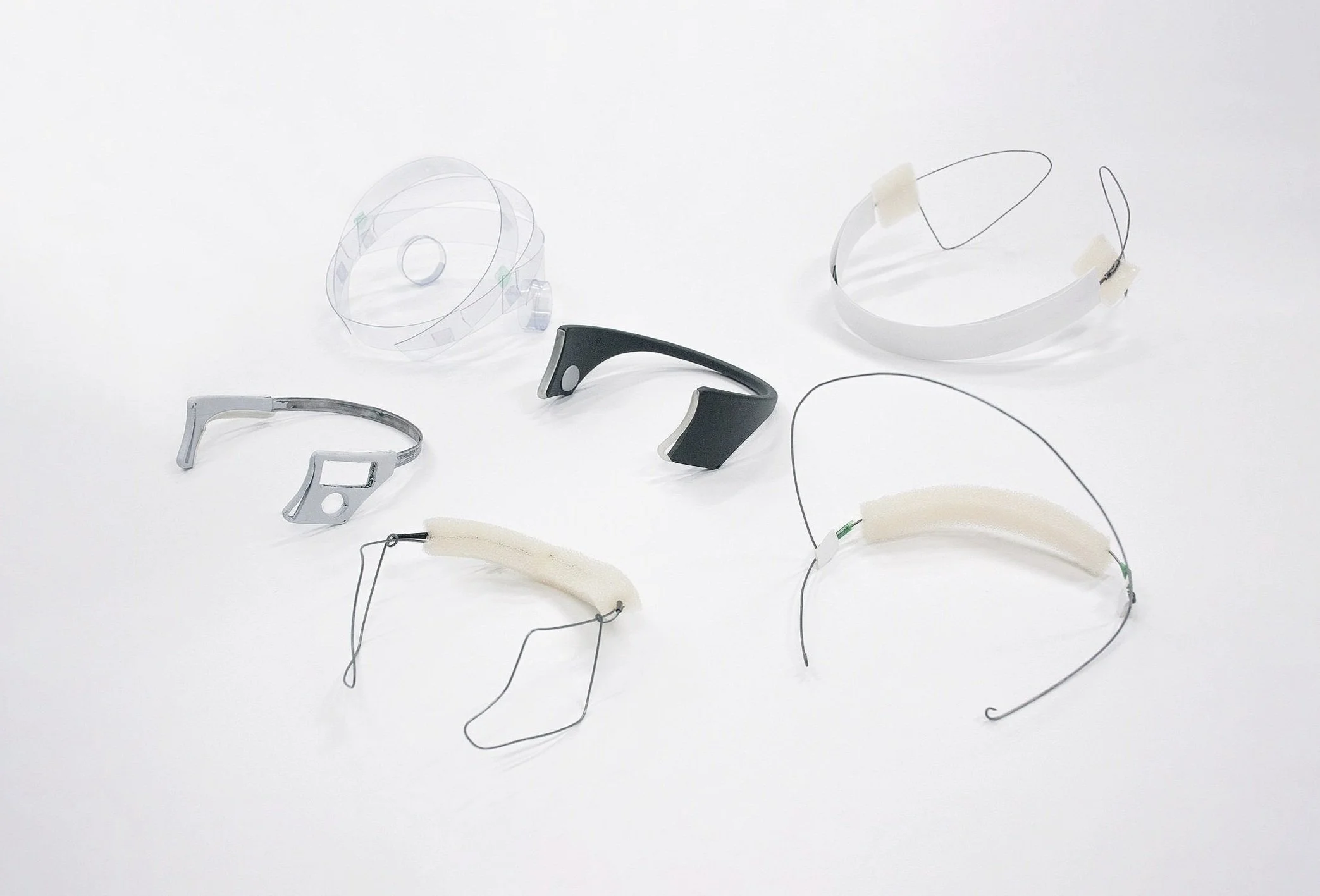
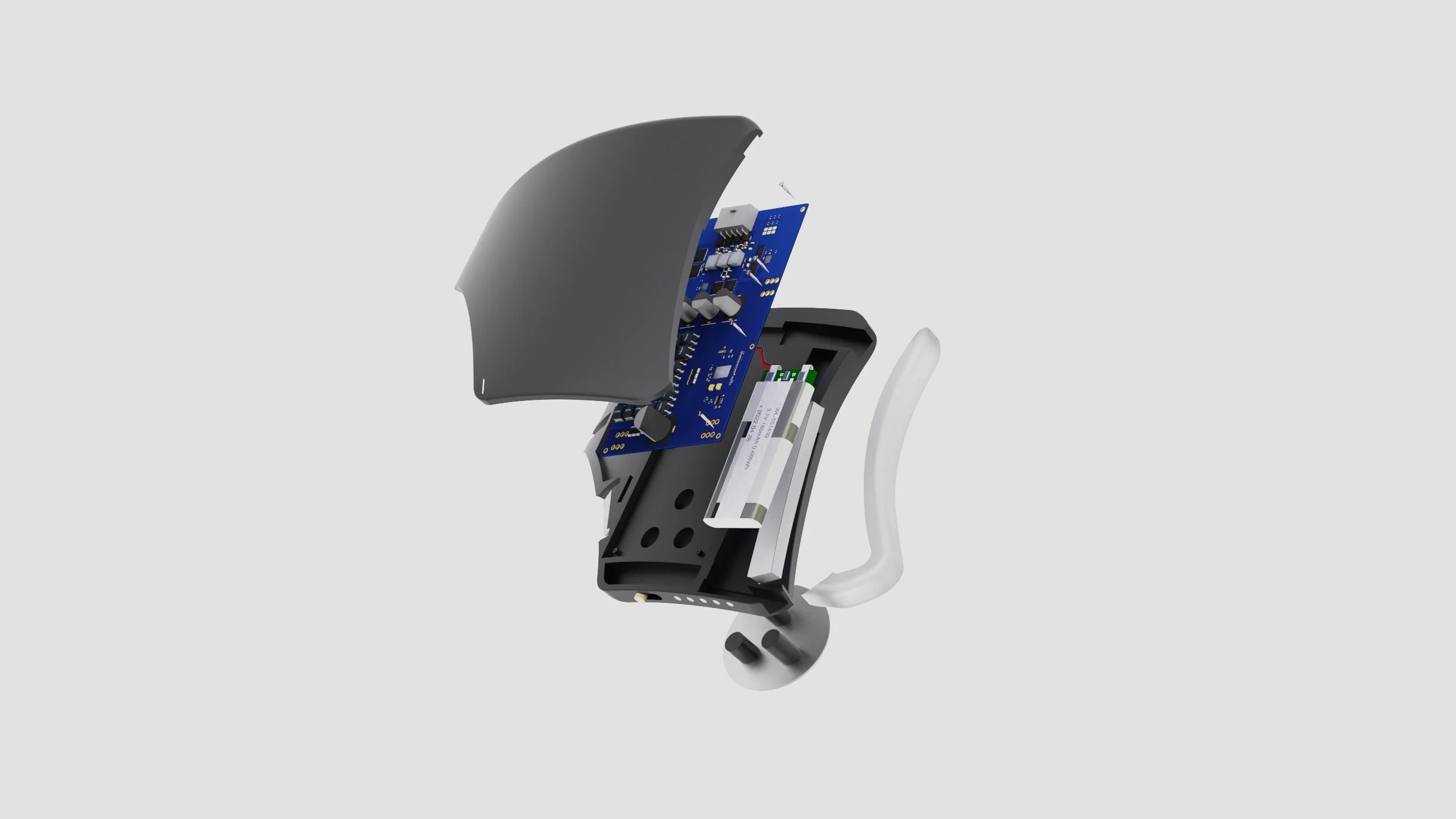
This early functional prototype brought the concept off the page and onto the body. Its exposed electronics and flexible rear band allowed us to explore component placement, assembly, and fit behind the ears before developing the refined outer form. It documents a step in the design process—not a validated demonstration that AMS+ reduces VR discomfort.
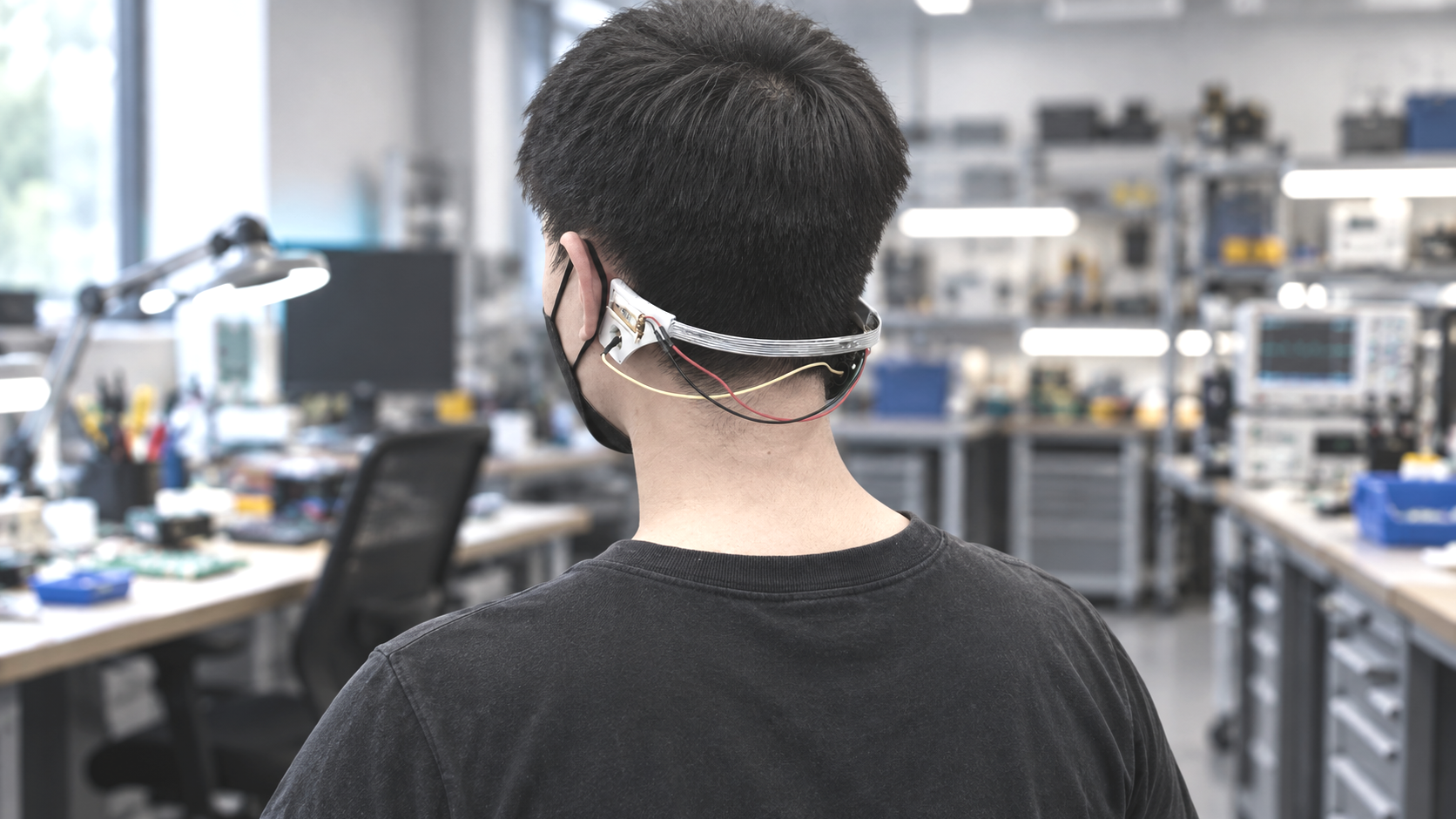
Prototype Validation Note: Early bench tests and fit trials were guided by clinical consultations and baseline safety protocols. These exploratory prototypes successfully validate form factor viability and electrode placement, paving the way for targeted clinical trials and parameter tuning."
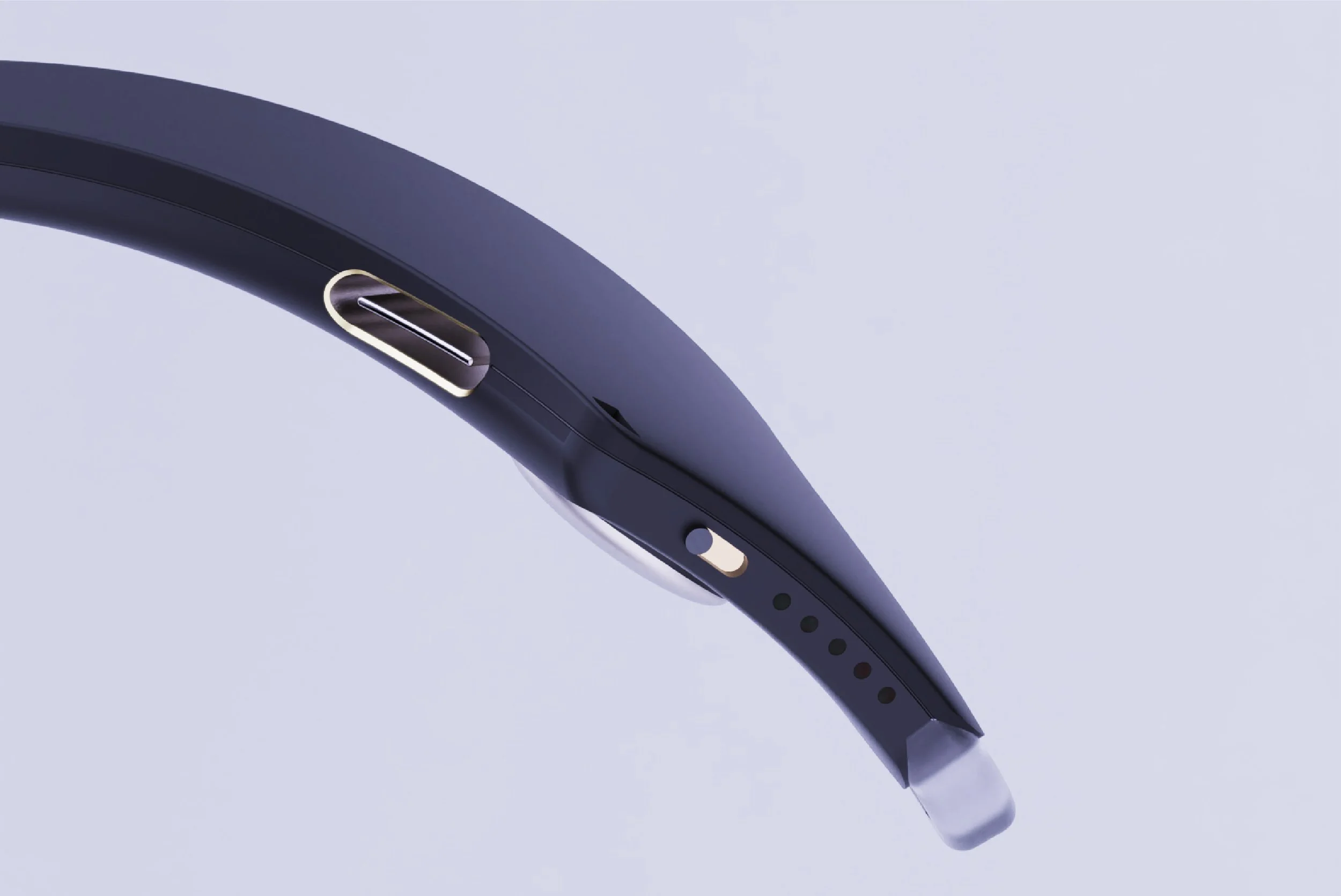
Proposed CMF specification
The design study unites a Type II matte-anodized titanium-alloy frame (#220 ceramic bead-blasted) with medical-grade liquid silicone (Shore A 45–60 durometer) to balance rigid structural support, adaptive soft contact, and long-wear comfort.
Precision-sealed enclosures integrate dry PVD-coated electrode pods, ensuring sweat-resistant durability and reliable conductivity within a quiet, refined minimal aesthetic.
Interaction & Closed-Loop Sensory Flow
A. User Journey & System States
01

Fit & Contact Detection
Binaural clip rests on the mastoid region; auto-senses skin contact impedance before initiating wireless link.
03

02
Spatial Calibration
Syncs with headset IMU to establish individual motion baselines and virtual coordinate alignment.

Adaptive In-Session GVS
Modulates low-amplitude micro-currents in real time based on angular velocity and optic flow acceleration.

04
Session Telemetry
Logs session duration, stimulus frequency, and user-rated comfort trends to refine personalized thresholds.

B. Closed-Loop Sensory Alignment
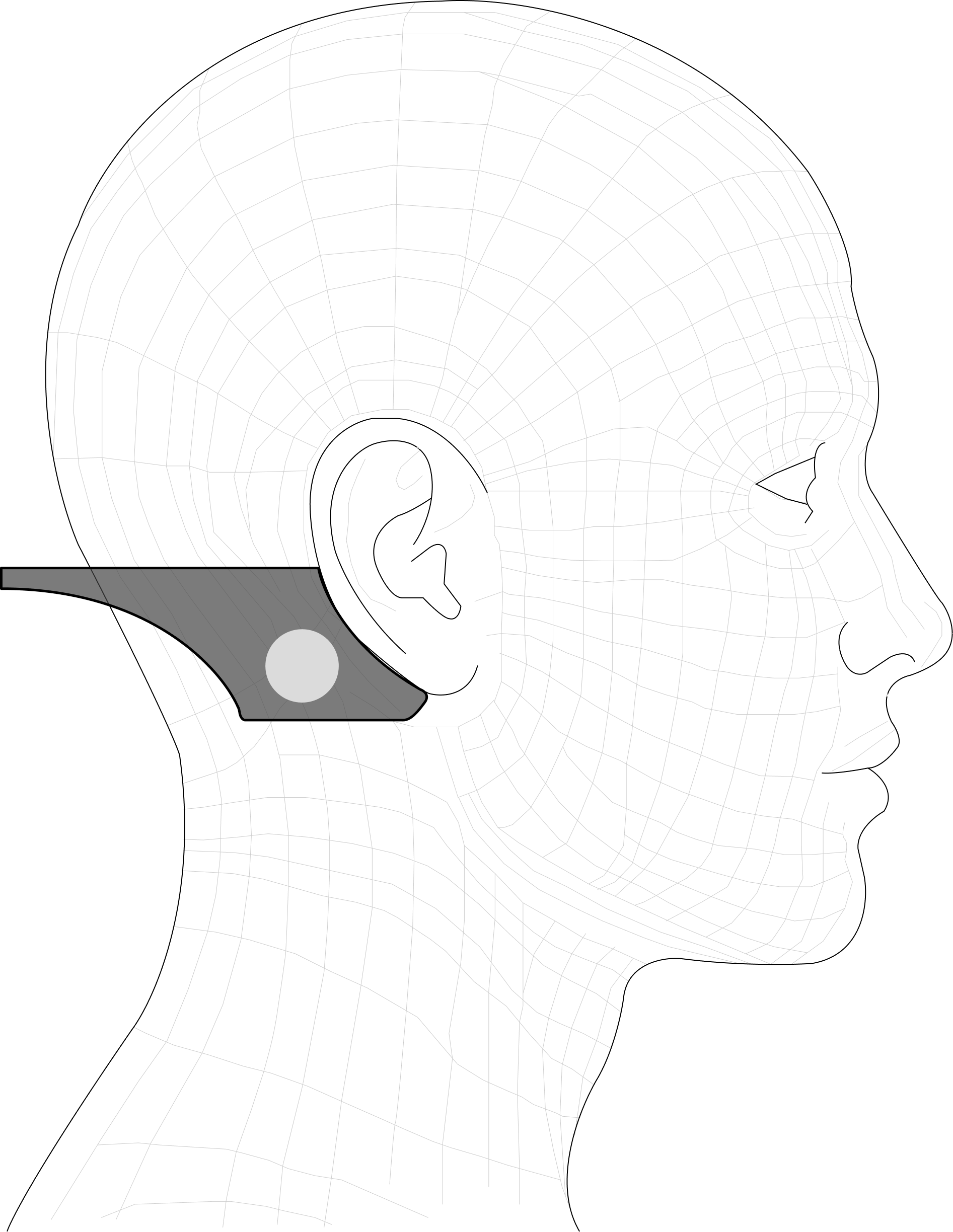
AMS+ CLIP
MASTOID REGION
+Wireless sync
+GVS delivery
Biometric sensing

Optic Flow & Head IMU
Captures 6-DoF head kinematics (IMU) and virtual angular velocity (Optic Flow) at low latency (<20 ms).

Conflict Calculation
Quantifies the mismatch vector between perceived visual acceleration and actual physical movement.

Binaural GVS Modulation
Delivers low-intensity binaural current to modulate vestibular afferent firing rates.

Sensory Congruence
Restores balance between visual and vestibular cues, attenuating disorientation during dynamic VR navigation.



C. Multi-Modal Interface
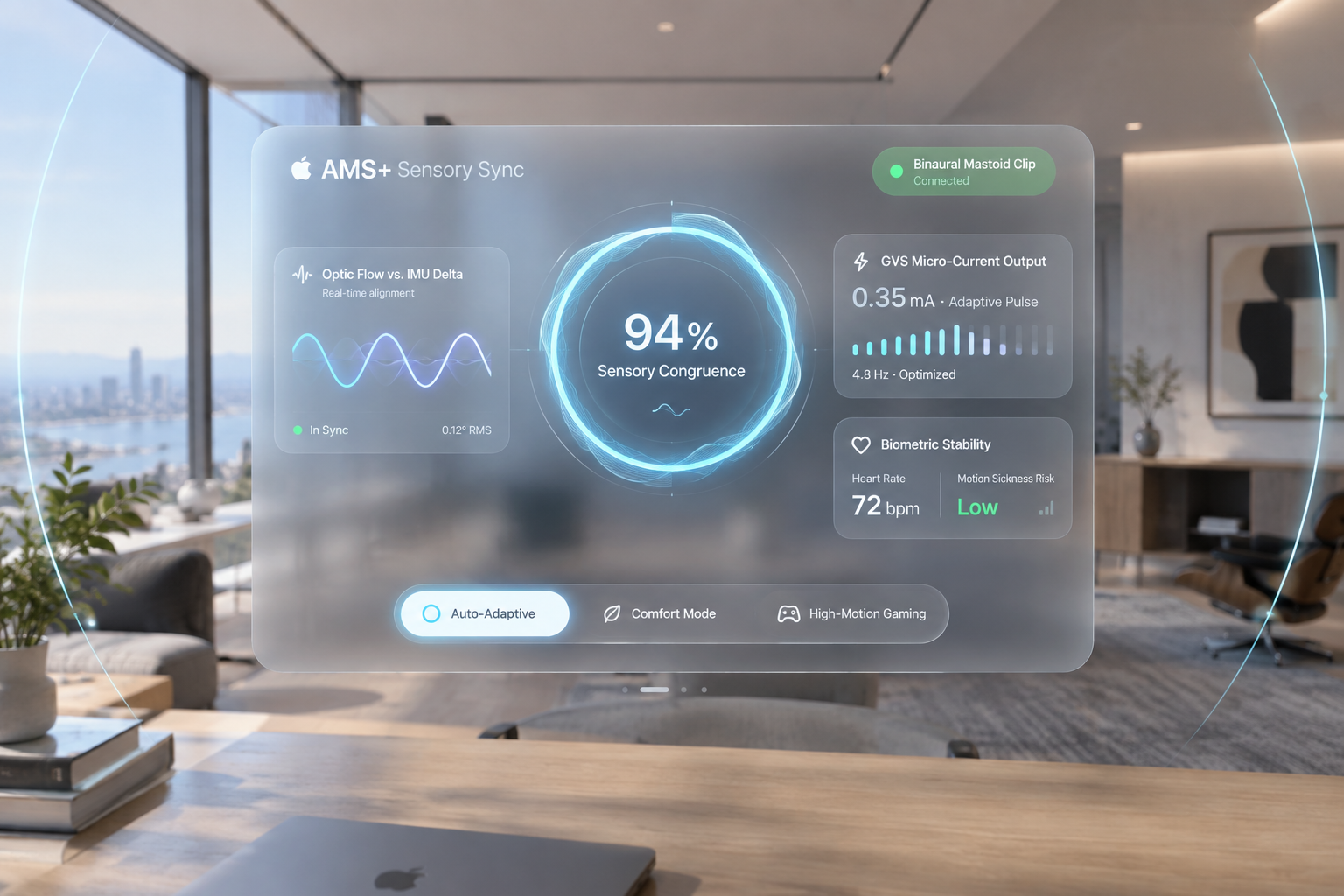
Interface Design Logic
The visionOS interface is built on the principle of ambient spatial clarity and zero cognitive load, seamlessly pairing a central floating glass dashboard with non-intrusive peripheral light cues.
Controlled via intuitive eye-gaze and pinch gestures, the translucent panel delivers at-a-glance telemetry on sensory congruence and adaptive GVS output, while subtle, low-opacity dynamic arcs at the outer visual edge silently indicate active acceleration compensation ensuring continuous balance and focus throughout deep spatial immersion.
Cross Device Hand-off Logic
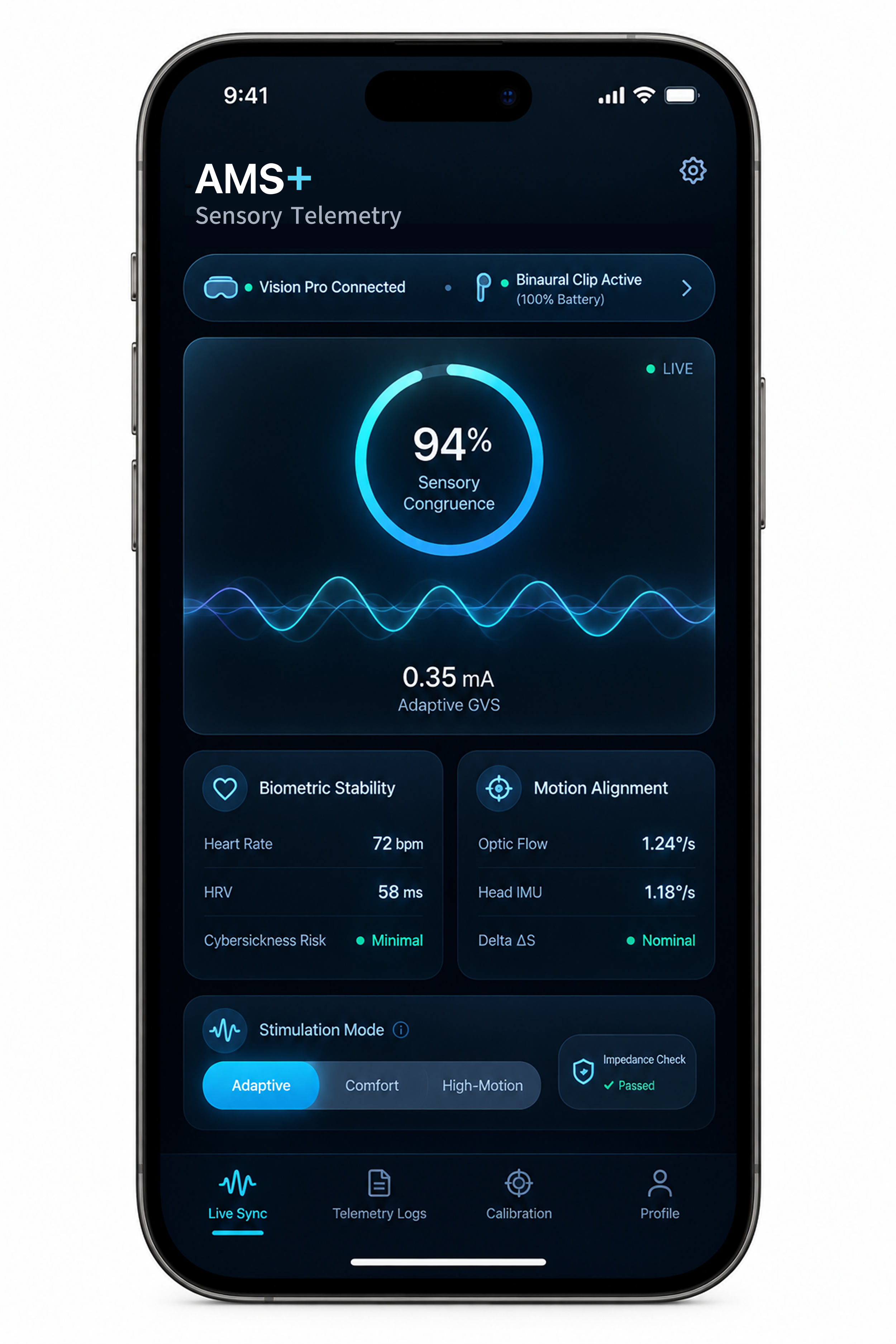
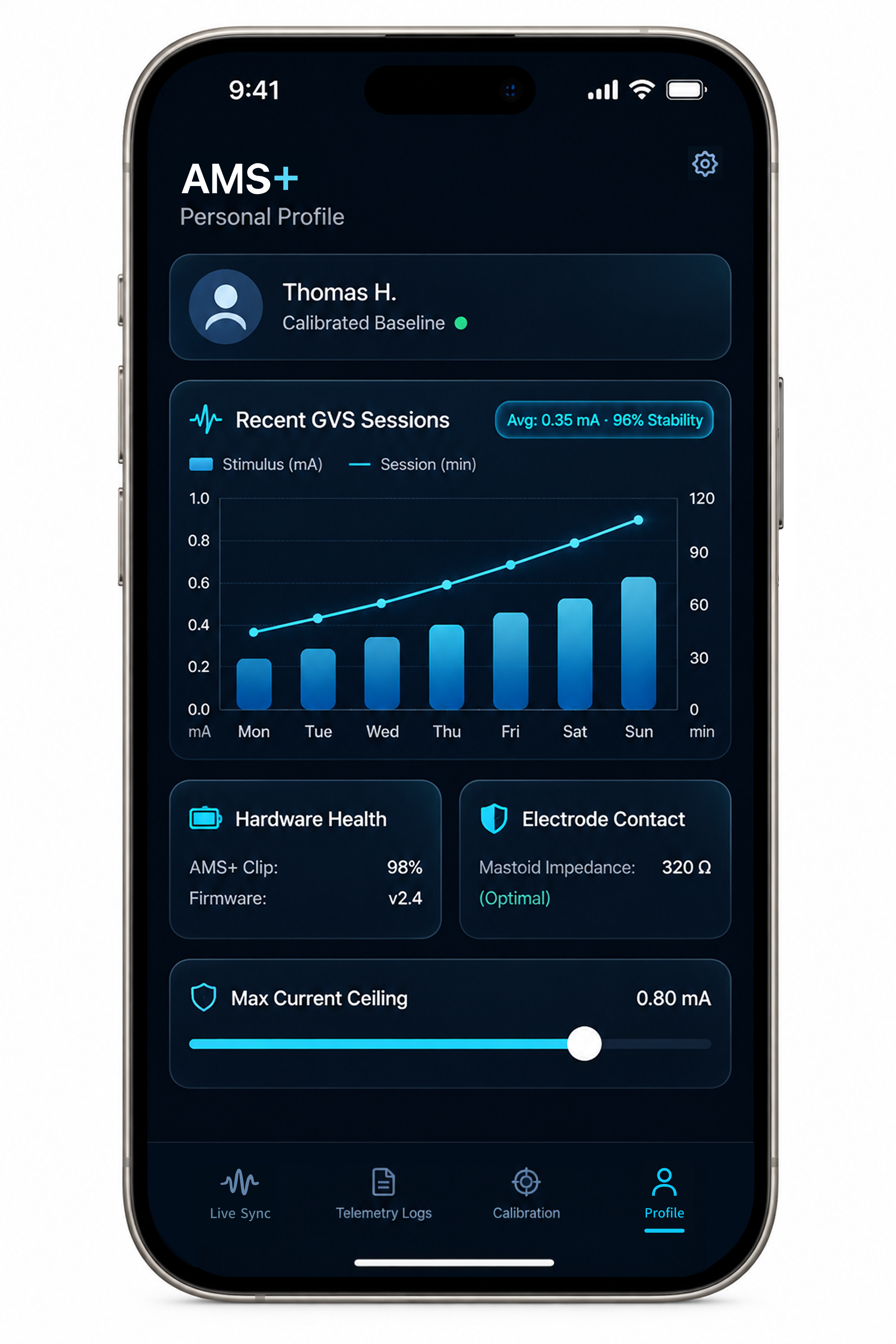
The cross-device hand-off creates a frictionless bridge between in-moment spatial stabilization on visionOS and longitudinal wellness tracking on iOS.
The moment the user removes the Vision Pro, the session automatically concludes and instantly transfers telemetry—including GVS current delivery, sensory congruence scores, and biometric recovery curves—to the companion iPhone app. This zero-touch workflow turns ephemeral immersion metrics into actionable personal health insights, continuously refining the individualized vestibular model for future sessions.
Use Cases
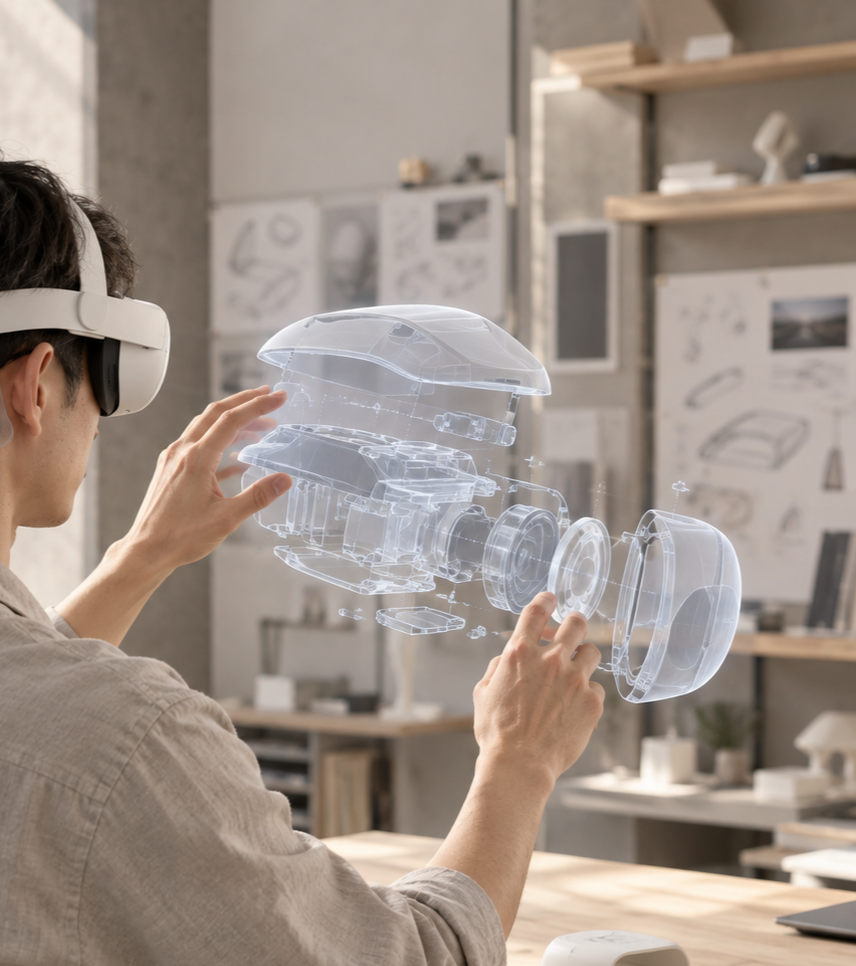
Design & Engineering Workflows
Think, sketch, and review in three dimensionsFrom 3D sketching and evaluating product proportions to examining assemblies and taking components apart virtually, AR/VR gives designers and engineers new ways to explore an idea before building a physical prototype. AMS+ explores how wearing comfort could become part of these immersive workflows—especially when a design session calls for sustained observation, movement, and discussion.
Brand Immersive Experiences
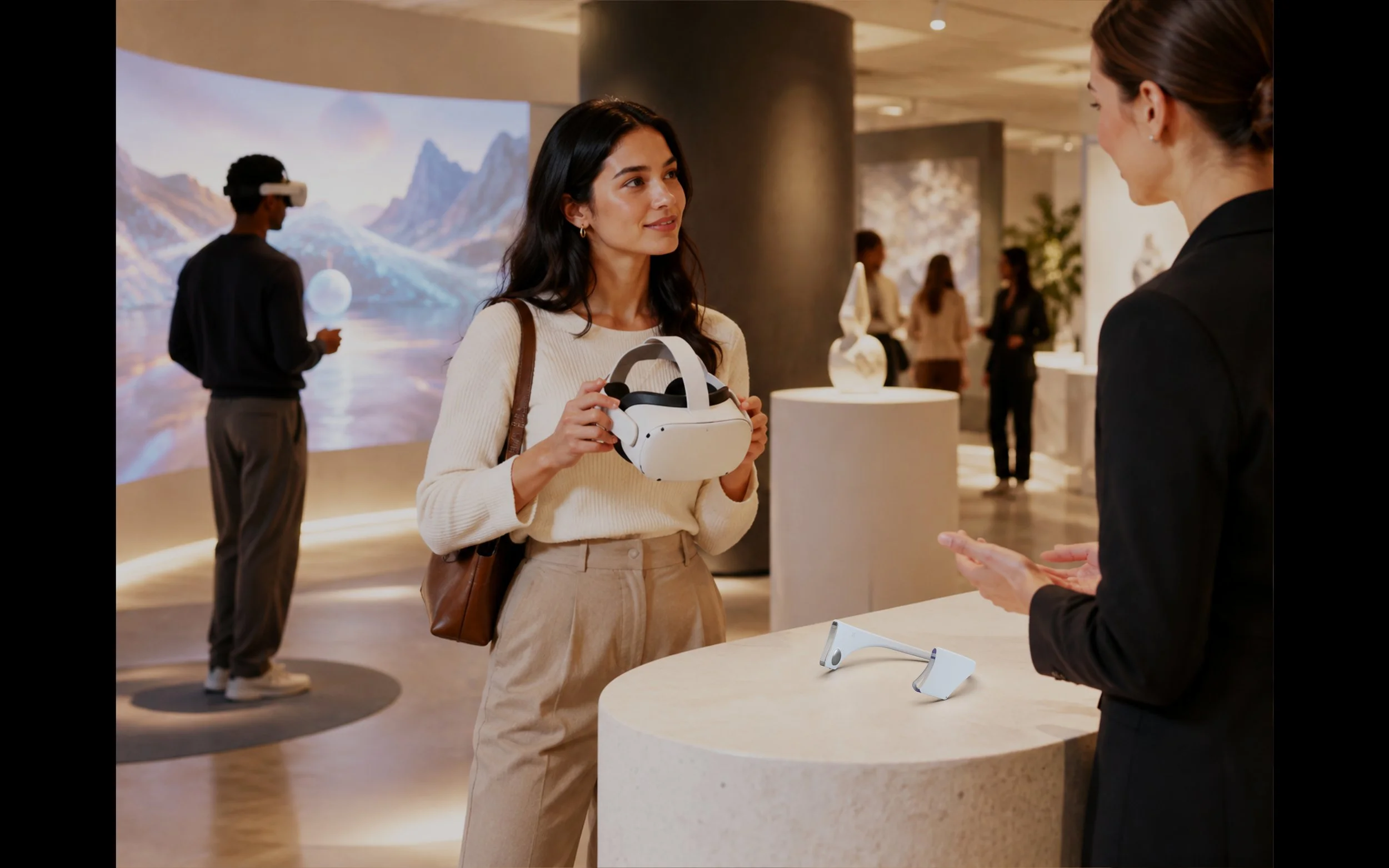
The first minute decides whether people stayIn exhibitions, retail spaces, live events, and product launches, VR often serves as the entry point for attention. For first-time users, however, comfort may determine whether they choose to continue exploring. AMS+ introduces the possibility of integrating wearable comfort support into the experience journey—treating comfort as part of brand-experience design rather than a problem addressed only after it occurs.
Spatial Presentation · Brand Activation · Education & Training · Remote Collaboration · Immersive Content
Spatial and Architectural Presentations
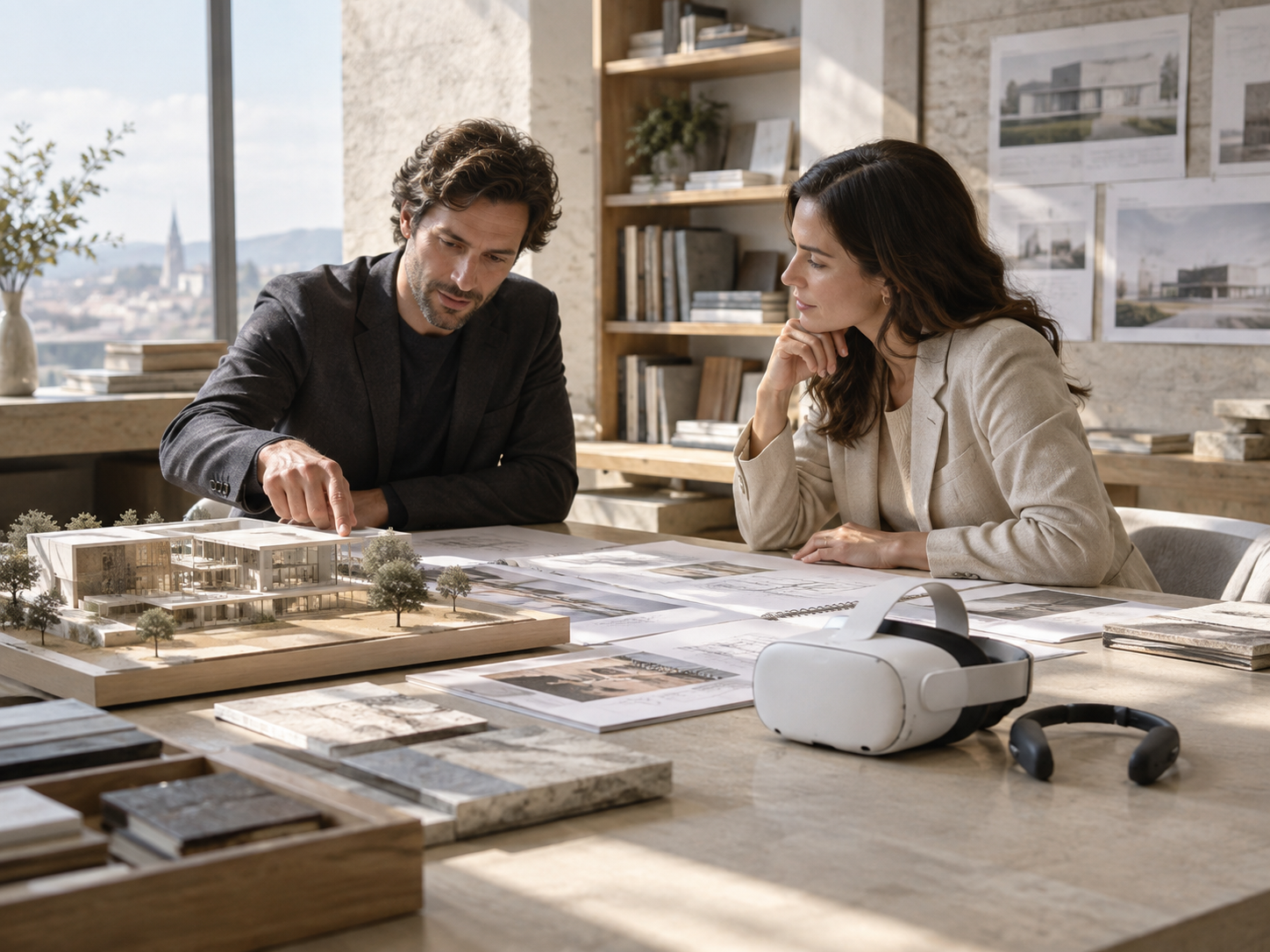
Let people feel the space—not just view itFor architects, interior designers, and spatial brands, VR makes it possible to enter an environment before it exists. Yet when a client feels dizzy or uncomfortable during a key presentation, attention shifts away from the design itself and toward physical discomfort. AMS+ explores a more continuous and focused presentation flow, helping users keep their attention on space, material, light, and narrative.
Clinical Perspective
Early AMS+ research included a discussion with a specialist in dizziness and tinnitus. The interview examined the sensory basis of VR discomfort, the vestibular system’s role in balance and orientation, and the research context for mastoid-area vestibular stimulation.
The recording discusses VR and 3D experiences, visually induced dizziness, relevant academic research, and the fundamental principles of balance.
This conversation is not a medical endorsement of AMS+ or evidence of clinical efficacy. It provides a clinical perspective that helped frame questions of user safety, contact placement, individual variability, and future validation.
Interviewee
Dr. Dai-Lou Lin
Title
Specialist Physician
Interview Date
March 28, 2022
Consent
Verbal and written consent obtained.
Core references
-
Sra, M., Jain, A., & Maes, P. (2019). Adding proprioceptive feedback to virtual reality experiences using galvanic vestibular stimulation. Proceedings of the 2019 CHI Conference on Human Factors in Computing Systems.
https://doi.org/10.1145/3290605.3300905Sluydts, M., Curthoys, I., Vanspauwen, R., Papsin, B. C., Cushing, S. L., Ramos, A., et al. (2020). Electrical vestibular stimulation in humans: A narrative review. Audiology and Neurotology, 25, 6–24.
https://doi.org/10.1159/000502407Rebenitsch, L., & Owen, C. (2016). Review on cybersickness in applications and visual displays. Virtual Reality, 20(2), 101–125.
https://doi.org/10.1007/s10055-016-0285-9 -
Sluydts, M., Curthoys, I., Vanspauwen, R., Papsin, B. C., Cushing, S. L., Ramos, A., et al. (2020). Electrical vestibular stimulation in humans: A narrative review. Audiology and Neurotology, 25, 6–24.
https://doi.org/10.1159/000502407Fitzpatrick, R. C., & Day, B. L. (2004). Probing the human vestibular system with galvanic stimulation. Journal of Applied Physiology, 96(6), 2301–2316.
https://doi.org/10.1152/japplphysiol.00008.2004Angelaki, D. E., & Cullen, K. E. (2008). Vestibular system: The many facets of a multimodal sense. Annual Review of Neuroscience, 31, 125–150.
https://doi.org/10.1146/annurev.neuro.31.060407.125555Matsugi, A., Nagino, K., Shiozaki, T., Okada, Y., Mori, N., Nakamura, J., et al. (2021). No impact of stochastic galvanic vestibular stimulation on arterial pressure and heart rate variability in the elderly population. Frontiers in Human Neuroscience, 15, 646127.
https://doi.org/10.3389/fnhum.2021.646127Ahmed, R. A., El-Masry, A. M., Mohamed, M. M., et al. (2020). [Transmastoid galvanic vestibular stimulation combined with vestibular rehabilitation in chronic unilateral vestibular disorders]. The Egyptian Journal of Neurology, Psychiatry and Neurosurgery, 56, 75.
-
Weech, S., Varghese, J. P., & Barnett-Cowan, M. (2018). Estimating the sensorimotor components of cybersickness. Journal of Neurophysiology, 120(5), 2201–2217.
https://doi.org/10.1152/jn.00477.2018Rebenitsch, L., & Owen, C. (2016). Review on cybersickness in applications and visual displays. Virtual Reality, 20(2), 101–125.
https://doi.org/10.1007/s10055-016-0285-9
Project Statement